
You've done the business model canvas. You've run design sprints. You've attended the innovation workshops. And somehow... nothing sticks.
Innovation isn't created through frameworks. It's created through ecosystems.
Barbara Salopek, bestselling author of Future-Fit Innovation, TEDx speaker, and founder of Vinco, has spent over 20 years building innovation cultures that actually last.
Her approach challenges the toolkit mentality entirely. Innovation isn't something you implement, it's something you build across three interconnected levels: individual, group, and organizational.
In our conversation, we explore how to break through the invisible barriers holding you back, why your "fridge innovation" is more powerful than you realize, and how to build this muscle whether you're leading a team or working solo.
(Links to the full episode and Barbara's resources are at the end... feel free to listen while you read or save them to go deeper afterward.)
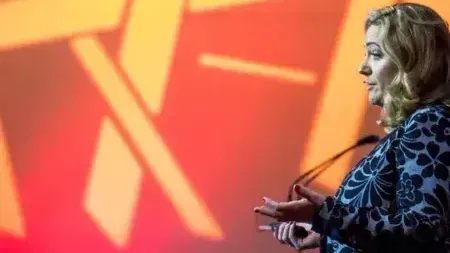
Barbara Salopek speaking on Future-Fit Innovation
The Innovation Ecosystem and Our Unique Roles
Most organizations treat innovation like a department. They train a few people in frameworks, appoint an innovation manager, and hope it spreads.
Barbara breaks it down differently.
Innovation works across three levels, and each has its own barriers:
Individual level: The biggest obstacles? People thinking "I'm not creative" (confusing artistic ability with creativity) and functional fixedness (seeing things only for their learned purposes). As Barbara puts it, "You can't ask people to be innovative if they're not comfortable with that." You have to create the environment in which they can move toward innovative thinking.
Group level: Diversity and psychological safety. Having different perspectives in the room means nothing if people don't feel safe voicing them. And here's the key: psychological safety isn't owned by the company. It's owned by the leader. You can have pockets of high and low safety within the same organization depending on who sets the tone.
Organizational level: Sustainability and technological advancement. These aren't separate initiatives... they're constraints that actually drive innovation when approached correctly.
For innovation to work, all three levels need to move in the same direction.
You can't have individuals building the muscle while organizational structures shut them down. You can't have leaders pushing for innovation without creating the safety for groups to experiment.
This matters whether you're a CEO or a solo creative. Your role is to understand where you sit in this ecosystem and how you can contribute to — or shift — the culture around you.
Functional Fixedness and How to Get Unstuck
Here's something our education and society reinforce that we rarely question: things have a unique purpose.
Tables are for eating at. Phone screens are for reading texts. Chairs need glue to hold them together.
This is functional fixedness - we see objects only for their learned functions. And it can severely limit our ability to innovate.
The example Barbara shares is perfect...
When mobile phones first emerged, they were for talking. Screens were secondary, just for reading text messages primarily. But Apple deconstructed the phone into its features and asked: what if the screen is the most important part?
The rest is history.
How to break functional fixedness:
- Deconstruct objects into smaller features — Don't look at the whole. Look at the parts.
- Assign new functions to those features — What else could this do?
- Challenge your "shoulds" — When you think "this is how we've always done it," pause.
The Norwegian furniture company Flokk did this brilliantly. Instead of asking "what materials should we use for sustainable chairs," they asked "what if we didn't use glue at all?" Now their chairs are fully recyclable because they designed the assembly process differently.
This applies to your work too.
What process step do you assume is necessary?
What if you removed it?
What feature of your service could become the centerpiece instead of the add-on?
Deep Knowledge Fuels Creativity
If you've ever thought "I'm not (a) creative," this is for you.
Barbara pushes back on the idea that school kills creativity. School doesn't kill it... school gives you deep knowledge. And deep knowledge is the foundation of all creativity, and not just the artistic kind.
A great pianist has deep knowledge of music theory, technique, and practice.
A scientist has deep knowledge of their field of study.
And when you've been working at a company for years, running the same processes, solving the same problems? You have deep knowledge, too.
Creativity isn't magic. It's combining what you know in new ways.
This is especially powerful if you're multipassionate or have changed industries.
Research shows that switching industries actually makes you more creative because you bring a different lens. You compare approaches. You see what others miss. You build richer knowledge by connecting domains.
That career shift from hospitality to tech? That's not a gap... it's deep knowledge about customer experience most engineers don't have. A decade in finance plus new design skills? The overlap creates combinations no one else can make.
The thread between your interests isn't scattered. It's deep knowledge, perspective, and experience. That's where your creative power thrives!
Fridge Innovation is Your Untapped Creative Power
Barbara and her colleague coined this term, and it's one of the most relatable innovation concepts I've heard.
You open the fridge.
You're hungry.
You have some things, but not enough to make a specific recipe.
No milk or eggs!
But somehow, you still make something to eat.
Why? Because you have deep knowledge about cooking or assembling something to eat. You don't stand there paralyzed saying, "I can't make something without milk." You combine what you have and solve the problem.
This is everyday innovation... incremental and process-oriented. And it's happening all the time without you realizing it.
At work, this looks like fixing a bottleneck in your workflow, finding a workaround when a tool breaks, combining two ideas no one thought to put together. These aren't breakthrough innovations, but they decrease costs, improve efficiency, and compound over time.
And here's the kicker: breakthrough innovations often come from these small shifts. Scientists don't discover cures overnight – they run tiny experiments, fail repeatedly, solve one small thing for one person, and suddenly realize there's a systemic benefit.
Fridge innovation is how you build the muscle. Start noticing when you're doing it and value it. And find ways to encourage others to use theirs.
Building and Flexing Your Innovation Muscle
Here are the moves Barbara and I explored:
1. Embrace diversity as an innovation asset, not a moral imperative
Yes, diversity is equitable. But it's also strategic. Different lived experiences = different lenses. Developing a women's product in a room full of men? You're missing critical perspectives. This applies to industries, countries, backgrounds, ways of thinking. Diversity fuels better ideas when people feel safe voicing them.
2. Experiment small
Barbara's cousin once asked her why she always ordered vanilla or chocolate ice cream. "Why don't you experiment?" Small experiments build the muscle. Change your running route. Turn off GPS in your own city and explore. Try a different approach to a familiar task. It trains you to see options instead of defaults.
3. Use constraints as fuel
Sustainability isn't a burden — it's a driver. When you can't throw things away as easily, when you have to think about waste, when regulations force you to adapt, you get creative. Porter's hypothesis supports this: properly designed regulations actually make organizations more innovative.
Ask yourself: What if we couldn't do this the old way? What if we removed this step? What if we had half the budget? Constraints open new solutions.
4. Question the "shoulds"
"This is how we've always done it" is functional fixedness at scale. Nokia thinking. Kodak thinking. When you hear yourself or your team say it, pause. Ask why. What would happen if we didn't?
5. Step outside your echo chamber
Social media locks us into the same thinking. Go to events where you don't know anyone. Talk to people in different fields... artists, architects, chemists, teachers. Be curious and ask questions. New conversations spark new ideas.
The Work Ahead
Innovation isn't a tool. It's not a workshop. It's not a framework you implement once and check off the list.
Innovation is a muscle you build. A culture you shape. An ecosystem you tend to whether you're leading an organization, building a venture, or navigating your own creative work.
Barbara's approach reminds us that this work is everyone's responsibility. Not the lone hero. Not the innovation manager carrying impossible weight. All of us, contributing to the climate that makes creativity possible.
So start small!
Notice your fridge innovations. Experiment with something today.
Question one "should," and build from there.
Listen to the Full Episode
🎧 Flex Your Innovation Muscle Beyond Frameworks with Barbara Salopek — Available now on all platforms, search your favorite!
We dig deeper into psychological safety, the lone hero trap, exploration vs. efficiency, how sustainability drives innovation, and more.
Spotify
Apple
YouTube
Enjoyed this episode?
Leave a review on Apple Podcasts or Spotify, or follow on YouTube for more conversations with founders and innovators.
Get Barbara's Book
📖 Future-Fit Innovation by Barbara Salopek
Available on Amazon (paperback, hardcover, Kindle). Grab the paperback to unlock bonus resources including worksheets, frameworks, and definitions at barbarasalopek.com
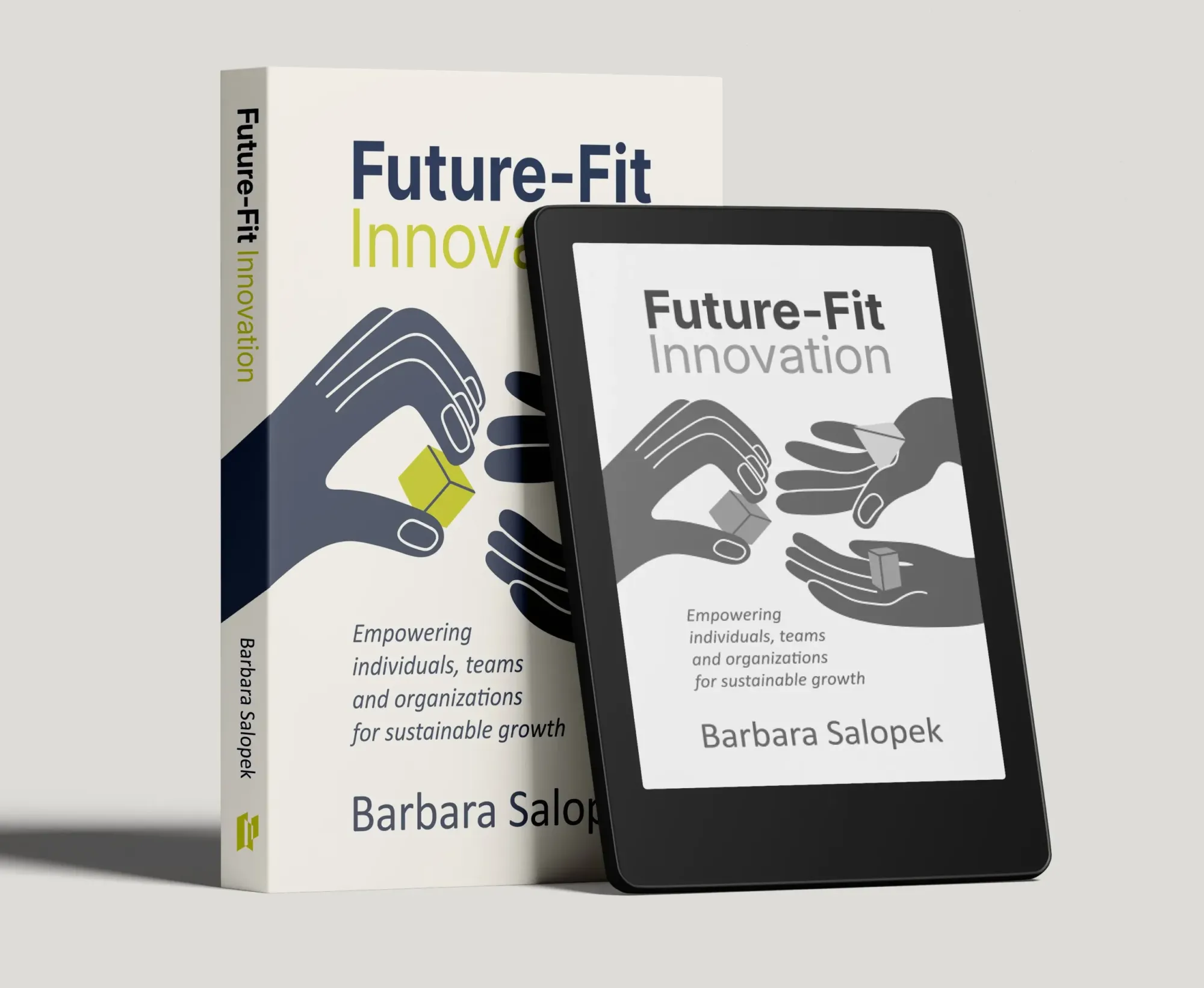
Future-Fit Innovation
by Barbara Salopek
In Future-Fit Innovation, Barbara Salopek presents a groundbreaking approach to driving sustainable and lasting innovation in organizations. By focusing on the often-overlooked dimensions of innovation management—individuals, groups, and organizations—this book offers a holistic framework that empowers leaders to build a culture where creativity, collaboration, and experimentation thrive. Packed with real-world examples, practical tools, and actionable strategies, Future-Fit Innovation equips forward-thinking leaders to overcome key obstacles such as resistance to change, lack of psychological safety, and misalignment between cultural values and strategic goals. Whether you’re leading a team, transforming your organization, or seeking to align innovation with sustainability and technological advancements, this book provides the insights you need to unlock innovation at every level and create meaningful, lasting change.
Connect with Barbara
🌐 Website: barbarasalopek.com
💼 LinkedIn: linkedin.com/in/barbara-salopek
🏢 Work with her: Vinco.no
Signal Sprint Session for Founders + Innovation Leaders
Jordan is currently taking on select 1:1 clients for venture design and innovation systems sessions.


